Dr. Phil Eminem Paternity Claim: Teen’s Photos Spark a Dispute Over Her Father
A teenager’s belief that rapper Eminem might be her father becomes the center of an unusual Dr. Phil interview when photographs, family memories, and conflicting explanations come under scrutiny.
The teenager says she has childhood pictures featuring a man who resembles Eminem. She also believes a photograph associated with the rapper shows her as a baby, even after Dr. Phil identifies the child as his daughter, Haley.
What begins as a question about physical resemblance develops into a disagreement about identity, family history, and the evidence needed to establish paternity.
The Dr. Phil Eminem paternity claim becomes particularly revealing when the teenager acknowledges uncertainty about her father while expressing strong confidence in her interpretation of the photographs.
Dr. Phil challenges her reasoning, but the conversation does not produce a DNA result or independently verified family records.
The case illustrates how personal beliefs can become difficult to evaluate when visual similarities are treated as proof and several competing explanations emerge.
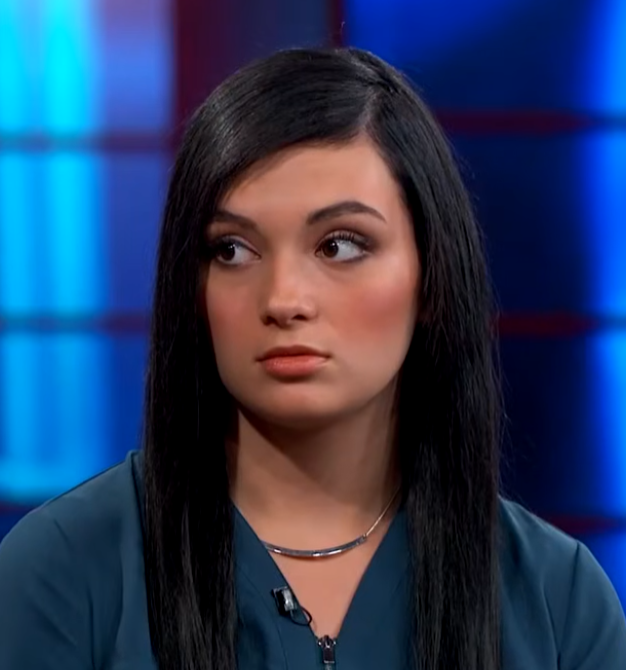
How the Dr. Phil Eminem Paternity Claim First Emerged
The interview begins with Dr. Phil asking the teenager whether she has told other people that Eminem is her father. Her answers reveal a distinction between what she has publicly claimed and what she can establish about her family history.
That distinction becomes central to the conversation because the teenager initially acknowledges uncertainty before presenting photographs as support for her belief.
The Teen Acknowledges Making the Paternity Claim
Dr. Phil opens with a direct question about whether the teenager has told people that Eminem is her father.
She confirms that she has.
When asked whether the rapper actually is her father, however, her answer is more cautious: “I am not sure”.
This response is significant because it establishes that the teenager does not initially present the relationship as a confirmed biological fact.
Instead, she explains that her belief comes partly from photographs kept by her mother.
She describes a childhood picture featuring a man who, in her opinion, looks remarkably similar to Eminem.
She also says she is sitting on the man’s lap.
The photograph appears to be important to her because she regards it as a connection between her childhood and the rapper.
However, the available transcript does not establish when the photograph was taken, who took it, or whether the man’s identity was independently verified.
The central question is therefore not whether the teenager possesses childhood photographs.
It is whether those photographs support the particular identity she assigns to the adult pictured with her.
A Family Member’s Identity Becomes an Immediate Disagreement
Another participant challenges the teenager’s interpretation of the childhood photograph.
The response identifies the man as a family member rather than Eminem.
The teenager continues to emphasize the resemblance, suggesting that the man looks like the rapper apart from certain differences in appearance.
This exchange introduces the first competing explanation for the photograph.
One interpretation identifies the person as a familiar family member. The teenager’s interpretation relies on his resemblance to a public figure.
The transcript does not provide independent documentation establishing the man’s identity.
Nevertheless, the disagreement highlights a limitation in the teenager’s reasoning.
Physical resemblance can explain why someone associates a person with a celebrity, but it does not establish that the two individuals are the same.
The teenager’s confidence in the resemblance is genuine within the conversation. Whether the resemblance supports her conclusion is a separate question.
Why the Childhood Photographs Become the Central Evidence
Photographs dominate the discussion because they are the main evidence the teenager offers for her belief. She refers both to pictures kept by her mother and to an image she says she found on Eminem’s page.
Dr. Phil challenges whether these images depict the people she believes they show, creating a dispute about identity rather than simply about physical resemblance.
The Teen Claims a Photograph of Haley Shows Her as a Baby
The teenager describes a childhood photograph that she says is available through her Facebook account.
She also claims to have found a picture on Eminem’s page that resembles her own baby photographs.
Dr. Phil identifies the child in the image as Eminem’s daughter, Haley.
The teenager continues to insist that the child resembles her.
Her argument depends on the similarity she perceives between the photograph and her childhood appearance.
Dr. Phil responds by emphasizing that resemblance does not establish identity.
He tells her, “that’s a different human being that’s not you”.
This is one of the interview’s most important factual challenges.
The teenager appears to move from believing that an image resembles her to asserting that the image actually depicts her.
Those are different claims requiring different levels of evidence.
The transcript does not provide independent photographic analysis, original image records, or other documentation establishing the disputed child’s identity.
It does, however, establish that Dr. Phil identifies the image as showing Haley and rejects the teenager’s interpretation.
Similar Appearances Do Not Establish Biological Relationships
The teenager repeatedly returns to the appearance of the child in the photograph.
She says, “look looks like me”.
At another point, she refers to having had a similar hairstyle during middle school.
These details explain why she finds the image familiar.
However, they do not establish that the photograph depicts her or that she shares a biological relationship with the person she believes is her father.
The interview illustrates how several observations can become connected in someone’s reasoning without independently verifying the conclusion.
The teenager sees a man who resembles Eminem in her family photographs.
She also sees a childhood photograph associated with the rapper that she believes resembles her.
She treats those similarities as related pieces of evidence.
The difficulty is that neither resemblance establishes identity.
Even if the two photographs appear similar, the transcript provides no verified connection between the people depicted.
Dr. Phil’s challenge focuses on that gap between observation and conclusion.
The Photographs in Her Mother’s Collection Raise More Questions
The teenager also refers to photographs kept in her mother’s personal collection.
She describes them as being stored in a notebook in a closet.
She identifies a man in those pictures as Mikey, although the automated transcript becomes fragmented while describing his relationship to the family.
This detail is important because it introduces another named individual who may be relevant to the childhood photographs.
However, the transcript does not establish Mikey’s full identity or biological relationship to the teenager.
The teenager later explains why she believes the pictures show her as a child.
She refers to matching clothing and hair color across different photographs.
Her explanation provides a reasonable basis for believing that some of the childhood images depict her.
It does not independently establish that the adult pictured with her is Eminem.
That distinction is essential.
Identifying the child in a photograph and identifying the adult beside that child are separate evidentiary questions.
The teenager’s ability to recognize her childhood clothing may support one identification without proving the other.
Credibility and Contradictions in the Teenager’s Explanation
The interview becomes more revealing as Dr. Phil questions the teenager’s reasoning. She offers several possible explanations for the photographs, including the possibility of another daughter and a suggestion involving babies being switched at birth.
These explanations raise credibility questions because they do not consistently support the same account of her family history.
Her Confidence Increases Despite the Unresolved Evidence
Early in the conversation, the teenager acknowledges that she is uncertain whether Eminem is her father.
Later, Dr. Phil asks whether she genuinely believes the relationship exists.
She answers, “I do yes I do”.
The shift is notable.
Her initial answer acknowledges uncertainty, while her later statements communicate much greater confidence.
However, the transcript does not reveal any new verified evidence that would explain the change.
The photographs remain the foundation of her claim.
Dr. Phil also asks whether she believes the proposed relationship would be unusual.
She responds, “I don’t think it’s that crazy honestly”.
This answer demonstrates that she considers the possibility plausible.
But plausibility and verification are different.
A person may believe that an event could have occurred without possessing evidence that it actually did.
The teenager’s statements establish her belief, not the biological relationship she believes exists.
The Two-Daughter Explanation Creates a Logical Problem
Dr. Phil repeatedly challenges the teenager’s interpretation of the photograph identified as showing Haley.
He asks whether she is suggesting that Eminem has two daughters with the same name.
The teenager responds, “who knows how many daughters he has named Haley”.
This introduces another possible explanation for the conflicting identities.
Rather than accepting Dr. Phil’s identification of the child, she suggests that another daughter might exist.
However, the transcript does not provide evidence supporting that possibility.
The suggestion also does not explain why a photograph identified as showing one daughter would establish that the teenager is another.
Dr. Phil’s questioning exposes this distinction.
Even if an additional family relationship were possible, its existence would still require independent evidence.
The teenager’s explanation therefore expands the range of possibilities without resolving the original question.
The Switched-at-Birth Theory Changes the Original Claim
The discussion becomes more complicated when the teenager introduces the possibility of babies being switched at birth.
She says, “sometimes kids do get Switched at Birth in the hospital”.
Dr. Phil challenges how that possibility fits her earlier statements.
The original claim concerns whether Eminem is her biological father.
The discussion of two daughters with the same name suggests a separate child might exist.
A switched-at-birth explanation introduces a different scenario involving the identities of children.
These possibilities cannot automatically be treated as interchangeable.
Each would require its own supporting evidence.
Dr. Phil attempts to clarify which explanation the teenager is actually presenting.
The exchange illustrates a central weakness in her argument: when one interpretation is challenged, she introduces another without establishing how the two fit together.
This does not prove that she is intentionally misleading anyone.
It demonstrates that her explanations are inconsistent within the available conversation.
Contact Attempts and the Missing DNA Evidence
The teenager’s account is not limited to photographs. She also describes trying to contact Eminem and expresses interest in a DNA test.
These details show that she has considered ways to investigate her belief, but neither establishes the relationship she claims.
Her Attempts to Contact Eminem Remain Unanswered
Dr. Phil asks whether the teenager believes she would have had contact with Eminem if he were her father.
She responds by describing attempts to reach him.
She says, “I did try to contact him actually through my Instagram”.
She also describes trying to find a private telephone number or another way to contact someone associated with him.
However, she reports receiving no response.
Her statement is direct: “I never got a call back or an answer back or anything like that”.
This is relevant because it establishes that, according to her account, she attempted to make contact.
It does not establish that Eminem received her messages or was aware of her claim.
Nor does the lack of a response confirm or disprove a biological relationship.
The transcript contains no communication records, verified correspondence, or statement from Eminem addressing the teenager’s allegation.
Therefore, the contact attempts provide information about her actions but do not resolve the central dispute.
A DNA-Test Request Is Not a Confirmed Result
The teenager also states, “I was trying to get a DNA test”.
This is the most directly relevant form of verification mentioned during the interview.
Unlike physical resemblance, a properly conducted biological relationship test could provide evidence directly relevant to the paternity question.
However, the teenager describes an attempted process rather than a completed one.
The transcript does not establish that a test was arranged, that samples were collected, or that any results were obtained.
It also does not establish whether Eminem was contacted about participating in such a process.
Consequently, the DNA-test statement cannot be presented as evidence confirming or disproving her claim.
It shows that the teenager recognizes, at least at this point in the conversation, that further verification would be relevant.
The absence of a documented test result remains one of the case’s most important evidentiary limitations.
Dr. Phil’s Privacy Decision Sets an Important Boundary
During the discussion about the photograph identified as showing Haley, Dr. Phil explains why he is not displaying the image.
He says, “I don’t want to violate her privacy”.
This statement establishes a boundary within the interview.
Although the teenager’s claim involves a public figure, Dr. Phil distinguishes that discussion from the privacy interests of another person shown in the photograph.
His decision also affects what the transcript can establish.
Readers cannot independently compare the disputed image or assess the visual similarities described by the participants.
The available material therefore supports an analysis of their statements rather than an independent determination of the photograph’s contents.
The privacy consideration is also relevant to the broader dispute.
Questions about one person’s biological relationships can involve other people whose personal information may become part of the discussion.
The interview demonstrates why public curiosity and an individual’s belief do not automatically justify exposing another person’s private information.
What the Dr. Phil Paternity Exchange Ultimately Establishes
The conversation ends without resolving the teenager’s claim. Dr. Phil continues challenging her interpretation of the photographs, while she maintains that her childhood pictures support her belief.
The most useful outcome is a clearer understanding of the evidence she relies on and the gaps that remain between that evidence and her conclusion.
No Verified Paternity Finding Emerges From the Interview
The teenager’s strongest evidence consists of photographs that she believes show a connection between her family and Eminem.
However, the identities of the relevant people are disputed.
Another participant identifies the man in one photograph as a family member, while Dr. Phil identifies the child in another image as Haley.
The teenager continues to rely on physical resemblance, matching childhood details, and possible alternative family relationships.
None of those explanations is independently verified in the available transcript.
Her reported attempts to contact Eminem also remain unanswered.
Although she mentions trying to obtain a DNA test, no result is provided.
The closing exchange returns to the disagreement about the man in the photograph.
Dr. Phil rejects the proposed resemblance, but the available material does not include independent identification records.
The final outcome cannot be confirmed from the available transcript.
There is no verified paternity finding, completed DNA test, legal ruling, or documented acknowledgment from Eminem.
The interview establishes that the teenager believes the relationship may exist. It does not establish that the relationship is real.
Practical Lessons About Evidence and Personal Beliefs
The central lesson is that resemblance should not be confused with identification.
A photograph may explain why someone develops a belief, but determining the identity of the people depicted requires more than perceived similarities.
Another important lesson concerns the difference between possibility and evidence.
The teenager introduces several possible explanations for the disputed photographs, but the existence of multiple possibilities does not establish that any particular one is accurate.
The conversation also demonstrates why consistency matters.
An explanation involving an additional daughter is not identical to an explanation involving babies being switched at birth.
Each requires a different set of facts.
Finally, the case highlights the importance of respecting privacy while examining personal claims.
The teenager’s uncertainty about her family history can be taken seriously without treating unverified claims about another person’s family as established facts.